

Minas Gerais, Brazil
East Salinas Rare Earth Project
Next-Gen Rare Earth Discovery with Tier-One Potential
The East Salinas Project is a strategically positioned rare earth exploration play in northern Minas Gerais, Brazil, covering over 22,000 hectares within the highly prospective Medina Intrusive Granitic Complex—adjacent to Brazil’s lithium valley—and offers year-round, low-cost field operations thanks to its favorable topography and infrastructure.
Project Highlights
- Emerging High-Grade REE Opportunity
The East Salinas Granitic Complex, situated within the East Brasiliano Orogen in northern Minas Gerais, has revealed highly anomalous surface geochemical results, with Total Rare Earth Oxides (TREO) grades reaching up to 2.17%. The project also boasts exceptionally high magnetic rare earth content, with NdPr (neodymium + praseodymium) oxide ratio reaching up to 38.8%, an average Heavy Rare Earth Oxide (HREO) ratio around 9.95% and average ytterbium oxide content around 387ppm. These results strongly support the presence of REE-bearing granite and leucogranite units, confirming the potential for high-grade hard-rock REE mineralisation across the project area. - Expanding Enova’s Strategic Footprint
East Salinas complements Enova’s REE exploration portfolio alongside Juquiá, CODA North, and CODA Central. The project’s large-scale tenement coverage and its association with post-collisional granites present multiple zones of interest, including the Bald Hill and Naked Hill targets, supporting further subsurface investigations and resource delineation. - Multi-Metal Potential and Geological Richness
In addition to REEs, East Salinas shows elevated levels of neodymium and other high-value heavy rare earth elements linked with evolved granitic systems. This opens potential for valuable by-products and broader resource development across the tenement package. - Leveraging Brazilian Expertise for Efficient Advancement
Enova’s Brazilian geology team has been instrumental in advancing exploration at East Salinas through detailed mapping, systematic sampling, and field validation. Their expertise ensures efficient progression from surface sampling to future drilling and geophysical surveys. - Cost-Conscious Exploration with Strong Growth Potential
Enova is adopting a disciplined, scalable exploration strategy at East Salinas focused on high-impact outcomes. With significant upside and a large tenement footprint, the project stands out as a cost-effective and potentially transformative REE discovery within Brazil’s resource-rich landscape.
Project Potential– East Salinas Project
| Category | Potential |
|---|---|
| Mining & Exploration | - Hosted in a large (~1,150 km²) granitic batholith with district-scale potential - High-grade REE mineralisation in coarse-grained granites with visible allanite - Excellent natural exposure via sugarloaf hills for efficient surface mapping - Low-relief terrain enables low-cost, year-round exploration activities |
| Processing | - Hard rock mineralogy (potential allanite??) supports conventional beneficiation routes - Potential for scalable, modular processing infrastructure - Granitic host rock may allow selective mining and targeted recovery |
| Product | - Contains critical rare earths (e.g., Nd, Pr) essential for permanent magnets - Hard rock REE sources typically yield higher-value concentrates - Potential for co-product synergies with nearby lithium and other critical minerals |
| Environmental | - Located in pastoral, low-density area with minimal land-use conflict - Hard rock REE mineral systems generally have lower environmental risk than ionic clays - Away from Environmentally sensitive area |
Geology
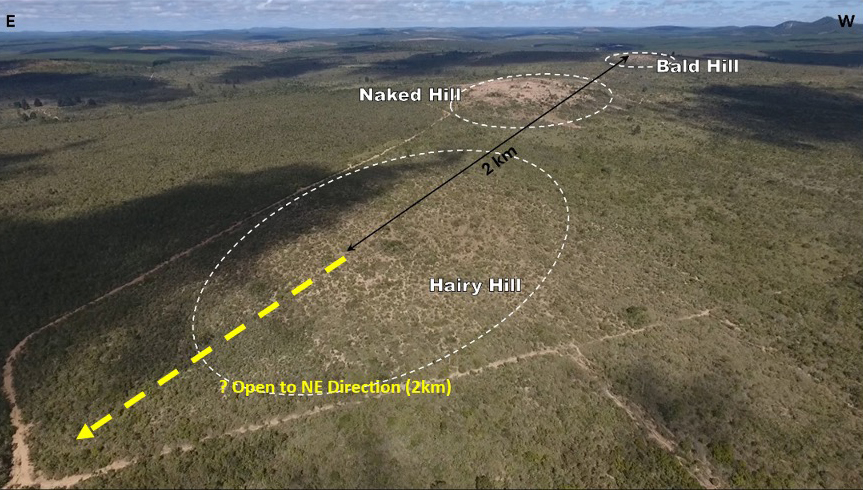
The Medina Intrusive Suite within the East Salinas Project features the Granito Maristela, a vast I-type granitic batholith spanning approximately 1,150 km², characterized by coarse-grained, metaluminous porphyritic granite with prominent feldspar megacrysts and accessory minerals like allanite; it hosts diverse xenoliths near its contact with the Salinas Formation and forms striking sugarloaf hills such as Serra do Anastácio, rising sharply above the surrounding Detrito-Lateritic Cover and saprolitic terrain.
The complex reflects Brasiliano orogenic magmatism, with the Maristela granite intruding and thermally reworking older crustal rocks. Its high relief and isotropic texture contrast sharply with the flattened morphology of the metasedimentary domain
The REE results are surface signatures of potential mineralisation. Style of potential mineralisation is Rare Element enriched hard rock deposit. The mineral system is open depth and strike extension which would be established through further exploration.
Rare earth grades confirm mineralisation
Assay results have been received from 295 drillhole core samples analysed by SGS Geosol Laboratory. Samples were collected from granite and granodiorite suites at Bald Hill and Naked Hill within the Medina Intrusive Complex. The results increase geological confidence in the presence of intrusive hosted REE mineralisation at depth and will inform the planning of future resource delineation drilling programs.
The recent diamond drilling program comprised 14 holes for a total of 989.63 metres, with 1,134 core samples collected across multiple target areas including Bald Hill, Naked Hill, Hairy Hill and Flat Hill. Drilling was designed to test the extent and continuity of REE mineralisation across the Medina Intrusive Complex.
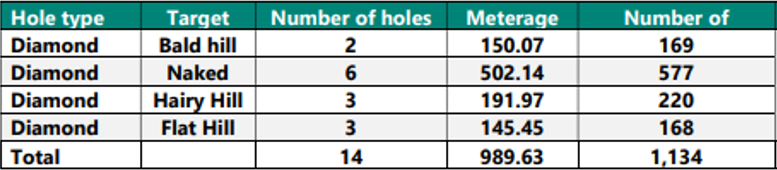
Table 1: Total drilling statistics in East Salinas
Core drill samples from the East Salinas Project returned multiple high-grade rare earth results, with several assays exceeding 1,000 ppm total rare earth oxides (TREO). Key intercepts in saprolite include:
- 12m@ 2,741ppm TREO and 23% NdPr from surface (EAS-DD-0001)
- 8m@ 1,482ppm TREO and 22.1% NdPr from surface (EAS-DD-0002)
- 13m@ 1,654ppm TREO and 16.8% NdPr from surface (EAS-DD-0003)
- 7 m @ 3,467 ppm TREO and 21.5% NdPr from surface (EAS-DD-0004)
Progress at East Salinas
Drillhole lithological data from the East Salinas Project indicate strong geological continuity along multiple intrusives bodies at the Naked Hill, Bald Hill, Hairy Hill and Flat Hill targets . The results support the interpretation that these targets are part of a larger, coherent intrusive body within the Medina Granitic Complex.
Drilling has intersected consistent lithologies and mineralised intervals across several intrusives, suggesting that surface outcrops represent exposed portions of a more extensive rare earth bearing system at depth. This interpretation supports the ongoing exploration strategy, which integrates geophysical data, hyperspectral analysis and targeted drilling to assess the scale, geometry and continuity of mineralisation across the project area.
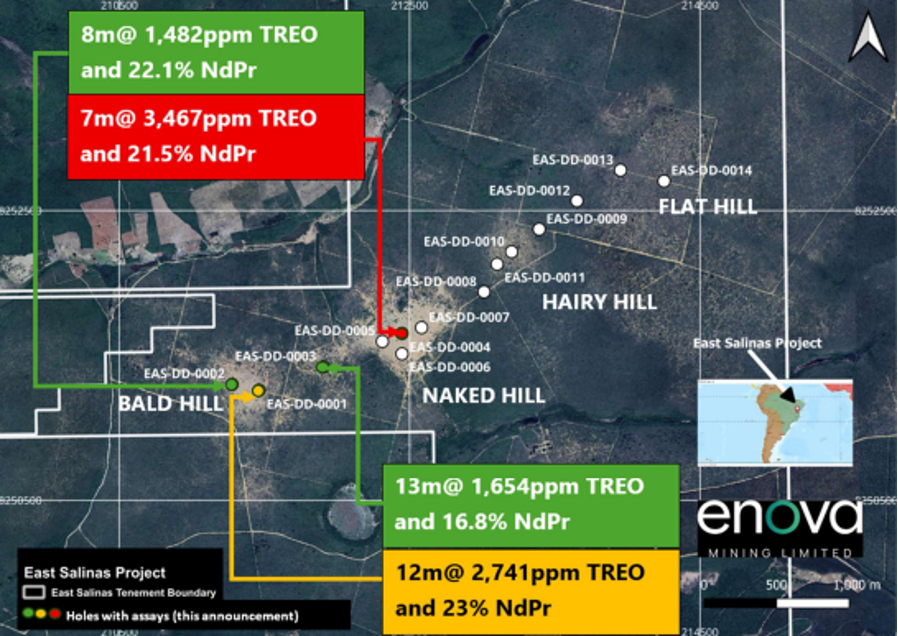
Figure 1: Diamond drillholes completed shown above
Metallurgical test work
Metallurgical test work was undertaken to assess a potential low-cost processing pathway. Leach testing was conducted by SGS Geosol Laboratory Vespasiano using its standard IAC leach test protocol on 13 consecutive downhole saprolite samples from drill hole EAS DD 0001. The sample interval comprised one sample from surface to 2m, followed by consecutive 1m drill run samples.
Samples received by the laboratory weighed greater than 3kg. Oversize material was sieved and reduced to -4mm prior to homogenisation. Each sample was split to generate a head grade aliquot and a leach test aliquot. Leach testing was conducted on 40-gram samples for 30minutes using 160ml of a cold-water solution containing 0.5 mol per litre AMSUL4 solution of pH 4. water solution containing 0.5 mol per litre AMSUL5 solution of pH 4. Following leaching, samples were filtered under vacuum and the residue washed with 80ml of 0.15 mol per litre AMSUL solution
Tenements/Permits
The East Salinas tenements are currently held by Mineração Paranaí Ltda and registered in the state of Minas Gerai. Upon completion of the permit in the official gazette, Mineração Paranaí Ltda will undertake the contractual process to transfer the title to Enova. Details of the East Salinas tenements are outlined in Table 2.
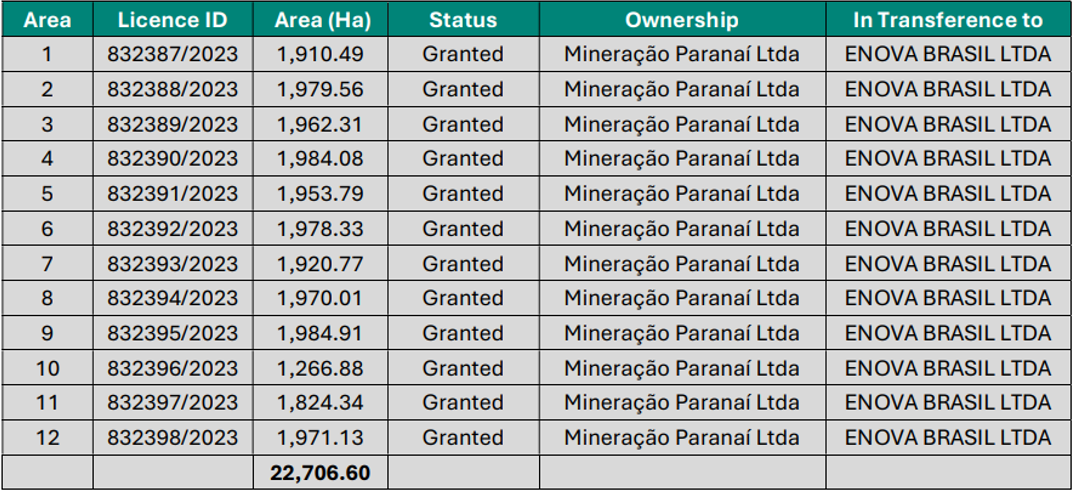
Table 2: East Salinas Project tenements Minas Gerais, Brazil